
By Nikki Ranney
Do you ever feel out of place in an art museum? Like you are missing something or being judged? The notion that Art and Museums are only for a specific kind of person is a pervasive misconception that I consider to be one of the biggest obstacles when it comes to getting people through the doors of an art museum. So, how can you feel more comfortable and get the most out of your museum experience? My recommendation is to slow down.
Depending on how closely you follow various art museums on social media, you may or may not be familiar with the term ‘Slow Art.’ Institutions like the Ashmolean and Museum of Fine Arts in Boston have participated in day-long events dedicated to Slow Art. What the Slow Art movement aims to do is encourage people to spend time with an artwork, not speed by on a mission to see every single thing on display. A study from 2017 showed that visitors to the Art Institute of Chicago spent an average of less than 30 seconds in front of a work of art before moving on.¹ 30 seconds is nowhere near enough time to make a meaningful connection. Slow Art invites viewers to really take their time, spending five minutes or even more just soaking in every last detail of a piece. Spending time with artwork opens your mind up to deeper thinking about societal context through critical analysis of a piece. Often, an artwork just makes you think about your own life, and that alone is such an incredibly poignant experience, even if it’s something as simple as a work reminding you of a loved one or inspiring you to pick up a paintbrush. Various studies over the last few decades have also begun to show that slowing down when looking at art can have a positive effect on health by reducing stress hormones.²
A question may be ‘but what am I looking for when I’m spending time staring at an artwork?’ and that’s an excellent question. The answers are never-ending, but I can mention a few of the things I think about to give you some ideas. When I look at an artwork, the first thing I’m thinking about is the subject matter. What is the work showing me? Is it realistic or abstract? How can I draw connections between the subject matter and my own lived experience? Do I enjoy looking at this or not? Why is that? Often one of my favorite things about looking at art is thinking about memories evoked by a work.
It is now I can reveal that one of the reasons for this little essay was actually to force everyone to look at one of my favorite comics of all time. The artist, Linda Barry, is a Wisconsin cartoonist who is currently a professor at the University of Wisconsin-Madison. Barry’s numerous accolades include a MacArthur Grant in 2019, The Wisconsin Visual Arts Lifetime Achievement Award in 2013, and an induction into the Eisner Hall of Fame in 2016. This all to say, Barry is a highly respected creator and I personally am a massive fan. The comic is featured on the back of Barry’s 2019 book Making Comics in which she walks readers through the creative process.
In the comic, two figures stand in front of a framed painting. The painting appears to be the baby Jesus sitting on the Virgin Mary’s lap— a pretty iconic subject in terms of religious art. The two main characters discuss a difficulty in understanding how to gain something from looking at art. The taller figure states that there’s supposed to be a ‘revelation’ or ‘something big’ that occurs. The smaller figure asks to be picked up to get a better view. The final panel in the comic shows the two main characters, one holding the other, in a mirror of the composition of the painting they’ve been discussing. This involuntary mimicry resulting in the viewer drawing comparisons between art and life is exactly how interacting with art goes. Sometimes an artwork calls to you immediately, and sometimes it takes time or a change before an artwork makes its impact. Barry’s comic immediately spoke to me (not only because I have a background in religious art and specifically images of the Virgin Mary) but because of the relationship that becomes so apparent in that final panel. Art and Reality mirror each other, and despite the character’s belief that “getting” art will result in something exciting or revelatory happening, sometimes it is a quiet understanding of how artwork relates back to ourselves.
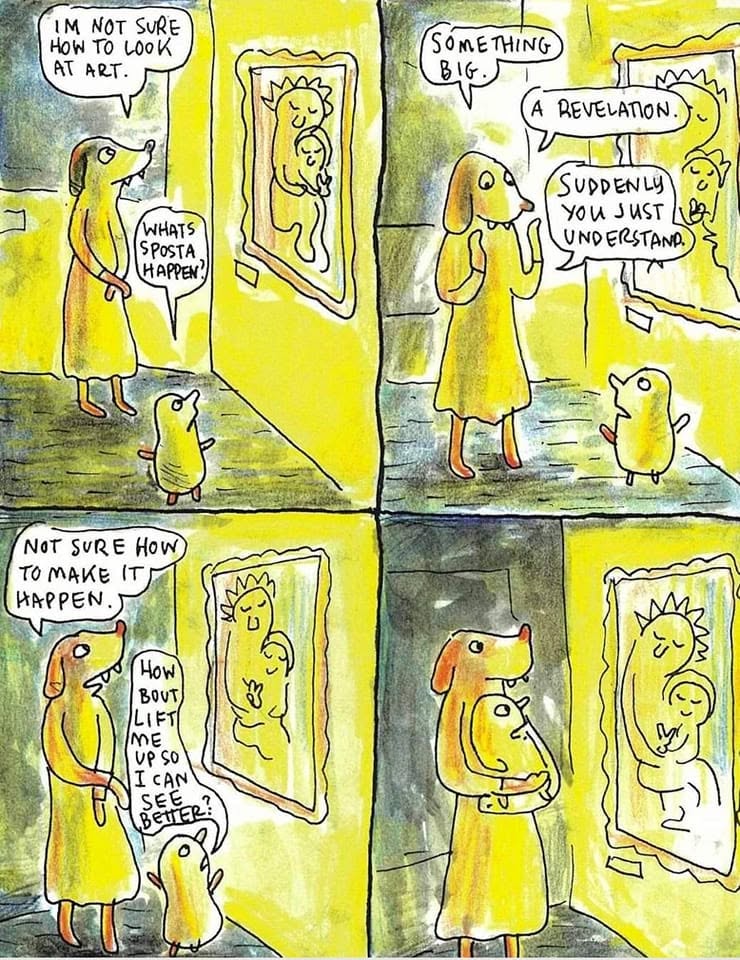
Image Credit: Lynda Barry, Making Comics, 2019.
Of course, spending time with art and critical analysis is absolutely not the only way to obtain something meaningful out of a trip to an art museum. Just ask my sister and father who spend all of our vacations gleefully making up inane facts about paintings held within the institutions I begged them to visit. Sometimes it is just about spending time with people you love, in a place that inspires joy. That is the core of it all. You should get out of art museums exactly what you want to get out of art museums (not the physical art though, that would be stealing). I only hope that in reading this you have learned new ways to gain more the next time you visit a museum. The Cedarburg Art Museum would love to have you come by and spend some time with our art. Afterall, art is for everyone.



Leave A Comment